Tuesday, March 8, 2016

Women's History Month: STEM-azing Facts about Ellen Ochoa


March is Women's History Month and as we celebrate the achievements that female STEM pioneers have engineered for us to make our lives easier, we here in Region 3 have decided to highlight the achievements of Ellen Ochoa (a space lover) in this month's Region 3 Blog Post. It also seems fitting that we highlight Ellen Ochoa and her accomplishments as the US enters its fifth decade in Space Exploration and understanding our complex universe.

Ellen Lauri Ochoa (born May 10, 1958) is a former astronaut and current Director of the Johnson Space Center. Ochoa became the first Hispanic woman in the world to go into space when she served on a nine-day mission aboard the shuttle Discovery in 1993.

Here are a few other STEM-azing facts about Ellen Ochoa:

1) Ellen Ochoa received a bachelor of science in physics from San Diego State
    University in 1980 and a master of science degree and doctorate in electrical
    engineering from Stanford University in 1981 and 1985, respectively.

2) Ellen Ochoa is a co-inventor on three patents for an optical inspection system, an
    optical object recognition method, and a method for noise removal in images.

3) Ellen Ochoa is a veteran of four space flights, logging more than 950 hours in
    space.

4) Ellen Ochoa's technical assignments have included flight software and computer
    hardware and robotics development, testing and training.

5) Ellen Ochoa was a crew member of STS-96 Discovery (May 27th to June 6, 1999),
    which was a 10-day mission during which the crew performed the first docking to the
    International Space Station.

For more information on Ellen Ochoa and her career, please click here.


Now lets take a closer look at and see how the students in expanded learning program 
have been engaged in STEM activities during the month of February.


Name of Expanded Learning Program Provider: Sacramento Chinese Community 
Service Center

Name of District(s): Sacramento City Unified School District

Name of School Site: Burbank High School 

Grade Level of Activity: 9th and 10th


Number of Students Who Took Part in The Activity: 20 students

Type of Activity: Computer Robotics and Programming (C-STEM Center UC Davis)

Learning Objectives of C-STEM Day:

C-STEM Day is organized to build public awareness and advocate for Integrated Computing and STEM education. The C-STEM Center and our partners organize curriculum-based RoboPlay Competitions in various regions on C-STEM Day at the end of May each year to further engage students in project-based team activities and to showcase their accomplishments and creativity not only in math and engineering, but also in writing, art, music, and film production.


Luther Burbank ASSETs students engaging in C-STEM activities.

For more information on the above STEM activities please contact Linda Vongthongkham at
linda@sccsc.org.


Name of Expanded Learning Program Provider: Sacramento Chinese Community 
Service Center

Name of District(s): Sacramento City Unified School District

Name of School Site: Rosemont High School 

Grade Level of Activity: 9th and 10th


Number of Students Who Took Part in The Activity: 20 students

Type of Activity: First Robotics


Learning Objectives of First Robotics: The mission of First is to inspire young people to be science and technology leaders, by engaging them in exciting Mentor-based programs that build science, engineering, and technology skills, that inspire innovation, and that foster well-rounded capabilities including self-confidence, communication, and leadership. 


Rosemont HS ASSETs students working on their First Robotics robot.


For more information on the above STEM activities please contact Brandon Alvarez at

brandon@sccsc.org.


STEM / Expanded Learning Program and Other Pertinent Educational Articles:

1) We Must Continue to Invest In After School Programs
    (Carlos Rojas, OC Register, March 5, 2016)

2) Why Students Should Take the Lead in Parent-Teacher Conferences (KQED, 2014)

3) Students Who Learn About Famous Scientists' Struggles Do Better In School 
    (Allison Eck, PBS, March 2,  2016)

4) Why Teaching Poetry is So Important
   (Andrew Simmons, The Atlantic, April 8, 2014)

5) Afterschool Special: Sacramento Youth Learn Food Literacy
    (Annamarie Sysling, Feedstock, March 3, 2016)

6) 5 Words and Phrases That Can Transform Your Work Life
   (Michael Grothaus, Fast Company, March 2, 2016)

7) Arts Integration Allows Students to Engage Abstract Concepts in New Ways
    (KQED, March 1, 2016)

8) State of Summer Learning (National Summer Learning Association)

9) 5 Questions to Ask Yourself About Your Unmotivated Students
   (Jennifer Gonzalez, Cult of Pedagogy, February 20, 2016)

10) The Wrong Way to Teach Math (Andrew Hacker, NY Times, February 27, 2016)

11) Research Shows Diverse Classrooms Improve Learning For Everyone
      (Anya Kamenetz, KQED, February 29, 2016)

12) How Poor Science Education in Kindergarten Harms Kids
      (Lydia Lum, The Atlantic, February 27, 2015)

13) Acting Ed. Secretary John B. King says he's a believer in after school
      (Jillian Luchner, Afterschool Alliance, February 25, 2016)

14) Understanding Gender Identity in Young People (LIAS Blog March 2016)


STEM (and other interdisciplinary core content) Activities / Videos / Websites:

1) Teach girls bravery, not perfection (TED Talk Video)

2) Elementary teacher creates "Gentleman's Club" to teach students life lessons
    (The Southern Weekend Video)

3) Sacramento Teen Wins CA Poetry Out Loud Competition (NPR Podcast)

4) How to Create a Culture of Trust (ALEX Kajitani Video)

5) Monroe Howard, SCUSD and Summer Learning (Sacramento and Co. Video)

6) 5 Books Guaranteed to Make Kids Love Science (Science Friday Book List)

7) PBL in the Arts Resource Guide (Education Closet- Free Resource)

8) Measurement - Monster Math Mix Up (Pinterest Resource)

9) Anti-Racism Activity: The Sneetches (Teaching Tolerance Activity)

10) Sci Girls STEM Activities (PBS Activities)

11) Great Video Resources for Teaching Math (Edutopia)

12) 10 Simple Interactive Whiteboard Tricks (Scholastic)

13) Resources for Filmmaking in the Classroom (Edutopia Resources)


STEM / Educational Grants:

1) National Council of Teachers of Mathematics (NCTM): Enhancing Student 
    Mathematics Learning Through the Use of Tools and Technology  
    ($3,000 grants are available)
    (Deadline: May 6, 2016)

2) Math Moves U: Math Hero Award (Math hero receives a $2,500 grant and school 
    receives a matching award) (Deadline: Applications open Spring of 2016)

3) Youth Service America (Grant Database) (Currently no grants available at 
    this time, but a great site to add to your "History" bar. )

4) Best Satellite Providers: Technology Grants for Educators 
    17 Resources for Future Proof Kids
    (Deadline: Varies by Grant Opportunity)


    (This webpage has been updated since January and offers new grants)


STEM / Misc. Professional Development / Contest / Events:

1) Enter the Cypher: Hip Hop Education Series - A three session workshop
    series focused around the best practices to empower Expanded Learning 
    Practitioners to use Hip Hop as an engaging and exciting tool within their 
    program. Presented by the Low End Theory Collaborative
    (Dates: March 15, and April 12) 
    (Fee: $22.00 per session)

    (Free) (March 23, 2016)

    ($150 per participant) (April 22, 2016)

4) CA STEM Symposium 2016 (October 9-11, 2016: Fee: $285 per participant 
     before April 30, 2016)


Thanks again for all that you do in the field. Please keep us posted about STEM events/activities in your area. Please feel free to contact us at any time.

Monica Gonzalez-Williams (SCOE: Region 3: After School Regional Lead):
mgonzalez@scoe.net

Phil Romig (SCOE: Science Curriculum Specialist): promig@scoe.net

Mark Drewes (SCOE: Project Specialist II: After School) mdrewes@scoe.net
     

Wednesday, February 17, 2016

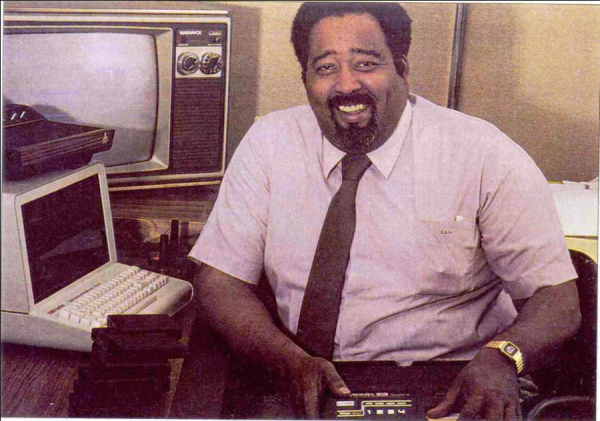
STEM-azing Facts About Jerry Lawson


Jerry Lawson and the gaming console that he invented. 


Gerald Anderson "Jerry"  Lawson (December 1, 1940 - April 9, 2011) was an African American electronic engineer known for his work in designing the Fairchild Channel F video game console.

The late Gerald Anderson was only one of two African Americans (the other being Ron Jones) to be a part of the exclusive Homebrew Computer Club in Silicon Valley. Other notables in the group were Steve Jobs and Steve Wozniak. The club began in 1975, when hobbyist, most with an electronic engineering or computer programming background, met to talk about the Altair 8800 and to exchange  schematics and programming tips.

Here are three facts about the Brooklyn born, self-taught electronic engineer that you might not know either:

1) Lawson was a self-taught engineer - While growing up in the projects of Queens in New 
    York City, Lawson got a start on his lifelong tinkering. His love for all things electronic and 
    gadget-y compelled him toward the engineer side of things. As a youth, he operated his own 
    ham radio and as a teenager he made money by repairing his neighbors' television sets.

2) Lawson founded and ran his own company - Videosoft, a video game development 
    company, was created by Lawson, who used it to produce cartridges for the Atari 2600. 
    When the 2600 came out, it effectively made the Channel F obsolete. Unfortunately, the 
    company only released one, which was a technician's tool called Color Bar Generator.

3) Lawson produced one of the industry's earliest arcade games - Debuting in a southern 
    California pizzeria only a few months after Allan Alcorn's Pong, Lawson's Demolition 
    Derby marked one of the earliest arcade games in the industry. Lawson would go on to 
    work with the Stanford University mentor program in an attempt to write a book on his 
    career.

For more facts on this great self-taught engineer please read Kevin L. Clark's Tech Times article on the life and times of Gerald Anderson "Jerry" Lawson. 

Now lets take a closer look at and see how the students in expanded learning program 
have been engaged in STEM activities during the month of January.


Name of Expanded Learning Program Provider: Target Excellence

Name of District(s): Elk Grove Unified School District and Sacramento City Unified  School District

Name of School Site: Roy Herburger Elementary (EGUSD), 
Sierra Enterprise Elementary (EGUSD), Ethel I. Baker (SCUSD)

Grade Level of Activity: 5th and 6th

Number of Students Who Took Part in The Activity: 20 per site

Type of Activities: Human Circuit - Conductors and Insulators, 

Catalytic Decomposition of Hydrogen Peroxide by Potassium Iodide,
Resonance: Tibetan Singing Bowls, Dancing Water, and Thunder Tubes,
Engineering Adventures

Learning Objectives of each Activity:

Human Circuit - Conductors and Insulators:

  • Understand that electricity is nothing more than free electrons moving from atom to atom through a material
  • Understand that the flow is called a current that goes in one direction at a time, and can be given a very strong charge or a very weak charge
  • Differentiate between conductors and insulators
  • Understand that transistors are electronic switches
Target Excellence learning about circuits while creating a human circuit.
Catalytic Decomposition of Hydrogen Peroxide by Potassium Iodide:
  • Understand the hazards and take the necessary precautions (e.g. wearing gloves and goggles)
  • Understand that the decomposition of hydrogen peroxide in the presence of iodide ion occurs in two steps: 1) H2O2 (aq) + I- (aq) = H2O (1) + OI- (aq) 2) H2O2 (aq) + OI- (aq) = H2O (1) + O2 (g) + I- (aq)
  • Differentiate between an exothermic and endothermic reaction
  • Understand that hydrogen peroxide molecules are very unstable and naturally decompose into water and oxygen gas
  • Understand that potassium iodide operated as a catalyst 
Target Excellence students learning about Catalytic Decomposition.

Resonance: Tibetan Singing Bowls, Dancing Water, and Thunder Tubes:
  • Understand that when an object vibrates at the natural frequency of another object resonance occurs
  • Identify Chladni (interference) patterns
  • Understand that every object has a natural frequency that vibrates when it is disturbed 
  • Understand that standing waves are produced by t he addition of two identical waves traveling simultaneously in opposite directions
  • Identify that hollow cavities are produced by the addition of two identical waves traveling simultaneously in opposite directions
  • Apply their knowledge to solve engineering problems relating to resonance
Engineering Adventures:
  • Learn that they can use the Engineering Design Process to solve problems
  • Learn that engineers design technologies that solve problems
  • Learn that they have talent and potential for designing and improving technologies
  • Be engaged in open ended challenges that are directly tied to NGSS standards
  • Learn to work in collaborative groups
Target Excellence students showing off their marshmallow tower.


A Target Excellence student writes in their Engineering Journal.

For more information on the above STEM activities please contact Jenna Boyd at jenna.boyd@targetexcellence.org


STEM / Expanded Learning and Other Pertinent Educational Articles: 

1) Save After School (Website on how individuals and organizations can work
    to sustain and increase the ASES program in California)

2) Why Talking about the Brain Can Empower Learners (KQED December 2014)

3) Promoting Literacy and Empathy in the Artroom 
    (Kimberly Campisano, January 26, 2016; KQED)

4) Stanford Study: "Culturally Relevant" Teaching Boosts GPA, Attendance for At-Risk Youth 
   (David Love, January 26, 2016; Atlanta Backstar)

5) What Core Skills Do Teachers Need to Be Effective? 
    (Emily Hanford, October 20, 2015; American Radioworks)

6) How a Lincoln High teacher gets all of his students to pass the AP Calculus exam
    (Steve Lopez, February 3, 2016; LA Times)

7) Know Thyself: Developing Your Inner Leader (National Afterschool Association)

8) SEL Skills and Employability (National Afterschool Association)

9) Finding the Math in Storybooks for Young Children 
    (Herbert P. Ginsburg, February 2, 2016, KQED)

10) Top 10 Time Tips for Trainers (Laura Stack, Training Magazine)

11) Major Push by White House to Increase Computer Science Skills 
      (Lauren Camera, January 30, 2016; US News)

12) California Case Studies Promote Summer Learning Over Summer School
      (Marva Hinton, February 8, 2016; Education Week) 

13) The Math Revolution (The Atlantic March 2016)

14) How to Get Your Kids Interested in STEM (Without Forcing It on Them)
      (Melanie Pinola, January 6, 2016; Lifehacker)

15) The Key to Boosting English Learners' Language Skills? Challenging Content
      (Katrina Schwartz, July 10, 2015; KQED) 

16) What Kids Need From Grown-Ups (But Aren't Getting)
       (Corey Turner, February 9, 2016; NPR) 


STEM (and other interdisciplinary core content) Activities / Videos / Websites:

1) USGS Science Resources for Primary Grades (K-6)

2) Teacher Uses Legos To Explain Math To School Children
    (Architecture and Design, December 2015)

3) 5 of our favorite Ted-Ed Lessons written by #WomenInSTEM
    (Laura McClure, February 11, 2016; Ted-Ed Blog)

4) Lesson Plan: Teaching With Protest Music
    ( Michael Gonchar and Katherine Schulten, February 4, 2016; NY Times Blog)

5) Flocabulary - Educational Hip Hop (A Few Free Resources)

6) A Big Ideas video series on Growth Mindset (ClassDojo: 5 free videos for kids)

7) How Limited Internet Access Can Subtract From Kids' Education
    ( Alina Selyukh February 8, 2016, NPR Podcast)

8) Open Ed NGSS Resources (Open Ed)

9) The Science of Getting Kids Organized
    (Karen Brown, February 2, 2016; NPR Podcast)

10) Youcubed (Stanford University Math Website with Resources for 
      Students and Parents)

11) New Resources on Social and Emotional Learning (AIR)

12) Stretchy Universe Slime (NASA Activity)

13) Sun Paper (NASA Activity)

14) Comet on a Stick (NASA Activity)

15) Make a stained glass Earth (NASA Activity)


STEM / Educational Grants:

1) National Council of Teachers of Mathematics (NCTM): Enhancing Student 
    Mathematics Learning Through the Use of Tools and Technology  
    ($3,000 grants are available)
    (Deadline: May 6, 2016)

2) Math Moves U: Math Hero Award (Math hero receives a $2,500 grant and school 
    receives a matching award) (Deadline: Applications open Spring of 2016)

3) Youth Service America (Grant Database) (Currently no grants available at 
    this time, but a great site to add to your "History" bar. )

4) Best Satellite Providers: Technology Grants for Educators 
    17 Resources for Future Proof Kids
    (Deadline: Varies by Grant Opportunity)


    (This webpage has been updated since January and offers new grants)


STEM / Misc. Professional Development / Contest / Events:


1) Enter the Cypher: Hip Hop Education Series - A three session workshop
    series focused around the best practices to empower Expanded Learning 
    Practitioners to use Hip Hop as an engaging and exciting tool within their 
    program. Presented by the Low End Theory Collaborative
    (Dates: February 17, March 15, and April 12) 
    (Fee: $22.00 per session)


    (Free) (February 24, 2016)

    (Free) (March 23, 2016)

    ($150 per participant) (April 22, 2016)

Thanks again for all that you do in the field. Please keep us posted about STEM events/activities in your area. Please feel free to contact us at any time.

Monica Gonzalez-Williams (SCOE: Region 3: After School Regional Lead):
mgonzalez@scoe.net

Phil Romig (SCOE: Science Curriculum Specialist): promig@scoe.net

Mark Drewes (SCOE: Project Specialist II: After School) mdrewes@scoe.net

Sunday, January 17, 2016

New STEM Activities for the New Year

NGSS: Things to Know for January 

1) New NGSS Equip Rubric: Evidence of Student Learning

2) Primary Science- Integrating NGSS and the Common Core

3) A Treat for Science Teachers - Evidence Statements

4) Science Standards Boost Learning 

5) Re-envisioning teacher preparation


STEM/ Expanded Learning and Other Pertinent Educational Articles:

1) Full STEM Ahead: Afterschool Programs Step Up as Key Partners
    in STEM Education (America After 3 PM)

2) CA After 3 PM: Full STEM Ahead (America After 3 PM Fact Sheet)

3) Engaging Kids in STEM Learning Infographics (America After 3 PM Infographic)

4) After - school program funding remains separate under new education law
    (Susan Frey, EdSource)

5) Looking Ahead to 2016: An Interview with Jennifer Peck (LIAS Blog)

6) Coding Camp for Minority Boys Where Mentors Make a Big Difference 
    (Elissa Nadworny, NPR)

7) That Aha! Moment of College or Career Readiness (Jason Tovani, Edutopia)

8) 5 Tools to Help Students Learn How to Learn (Katrina Schwartz, KQED)

9) Getting Your Kids to Listen Without Loosing Your Voice 
    (Amber and Andy Ankowski, PBS)

10) Want to Get More Girls Into STEM? Give Them Real-World Work
    (Katrina Schwartz, KQED)

11) Seeing Struggling Math Learners as "Sense Makers," Not "Mistake Makers"
     (Katrina Schwartz, KQED)

12) What Happen when instead of suspensions, kids talk out their mistakes? 
      (Emily Richmond, The Hechinger Report)

13) 5 Steps for Handling Upset Parents (National AfterSchool Association)

14) New Fitness Education Program in California Boosts Student Achievement
      (Stacy Steinhagen, News 12)


STEM (and other interdisciplinary core content) Activities / Videos / Websites:

1) Explorit Science Center (Activities, Teacher Resources, etc.)

2) The Discovery Museum Science Fun at Home (Science Activities)

3) Out of School Educator Tools (Science Resources)

4) Adding Beauty and Joy To Obama's Push for Computer Science Teaching
    (All Things Considered Radio Clip, NPR)

5) Chemist Wants To Change the Color of Science (Radio Clip, NPR) 

6) Hip-Hop Vocab: The Lexicon Is In The Lyrics
    (All Things Considered Radio Clip, NPR)

7) After School STEM Hub (Afterschool Alliance, STEM Advocacy Resources)

8) Click2 Science STEM Resources (Teacher Resources)

9) Mom Creates Periodic Table Battleship Game to Teach Her Kids Chemistry
    (Activity, Earthables)

10) Beyond Angry Birds, Five Apps That Test Your Physics Skills
      (Physics Resources, KQED)

11) Testing Insulators: Ice Cube in a Box (STEM Activity, PBS)

12) SciGirls Website (STEM website for Tween girls, PBS)


STEM / Educational Grants: 

1) Captain Planet Foundation: Grants are made for activities that: a) Are project-based 
     b) Are projects performed by youth c) Are projects that have real environmental 
     outcomes. ($500-$2,500 grants are available)
     (Deadline: January 31, 2016)

2) National Council of Teachers of Mathematic (NCTM): Enhancing Student 
    Mathematics Learning Through the Use of Tools and Technology  
    ($3,000 grants are available)
    (Deadline: May 6, 2016)

3) Math Moves U: Math Hero Award (Math hero receives a $2,500 grant and school 
    receives a matching award) (Deadline: Applications open Spring of 2016) 

    ($15,000 grants available)
     (Deadline: Ongoing)

5) Best Satellite Providers: Technology Grants for Educators: 
    17 Resources for Future Proof Kids
    (Deadline: Varies by Grant Opportunity)


STEM / Misc. Professional Development / Contest / Events:

1) Enter the Cypher: Hip Hop Education Series - A three session workshop
    series focused around the best practices to empower Expanded Learning 
    Practitioners to use Hip Hop as an engaging and exciting tool within their 
    program. Presented by the Low End Theory Collaborative
    (Dates: February 17, March 15, and April 12) 
    (Fee: $22.00 per session)

    (Free) (February 24, 2016)

3) Kidz Science (Grades 3-5) (Free) (March 1, 2016)

    (Free) (March 23, 2016)

Thanks again for all that you do in the field. Please keep us posted about STEM events/activities in your area. Please feel free to contact us at any time.

Monica Gonzalez-Williams (SCOE: Region 3: After School Regional Lead):
mgonzalez@scoe.net

Phil Romig (SCOE: Science Curriculum Specialist): promig@scoe.net

Mark Drewes (SCOE: Project Specialist II: After School) mdrewes@scoe.net