Showing posts with label Black History Month. Show all posts

Tuesday, January 30, 2018

February is Black History Month: Do you know about........

As we celebrate Black History Month with our students, let us also take time to highlight these hidden STEM figures:


Lewis Howard Latimer


1) Lewis Howard Latimer - Though Thomas Edison is recognized as the inventor of the light bulb, African-American inventor Lewis Latimer played an important role in its development. In 1881, Latimer patented a method for making carbon filaments, allowing light bulbs to burn for hours instead of minutes.


Dr. Jane Cook Wright
2) Dr. Jane Cooke Wright - After earning her medical degree in 1945 from New York Medical College, Dr. Wright went on to do pioneering work in cancer treatment. In 1949, she took a position at Harlem Hospital, where her father was the director of Cancer Research Foundation. After his death in 1952, she took his position at just age 33.


Ray Gilstrap - Electrical Engineer


3) Ray Gilstrap - An electrical engineer at NASA Ames Research Center. He has helped set up an maintain satellite internet services for different scientific expeditions. His work has taken him all over the world, including to an island in the Arctic where he helped with communications at a climate change research station.


Nancy Douyon - Human Factors Engineer
3) Nancy Douyon - A human factors engineer and user experience research program manager at GOOGLE. Among other projects, she works on making Android phones user-friendly, intuitive and adaptive to different users.


Here are some STEM / Black History Month Resources for you and your staff:

a) Build a Light Bulb - Circuits Activity

b) Engineering Activities

c) 28 Ways to Celebrate Black History Month (Scholastic Activities)

d) Black History Month Lessons and Resources (National Education Association)

e) 28 Days of Art Activities for Black History Month (Creative Child)

f) PBS Learning Media Black History Month Resources (PBS)

g) Black History Month Celebration (Crocker Art Museum)
    (Date: February 18, 2018) (Time: 12:00 pm to 4:00 pm)

h) CSUS Black History Month Events (CSUS)

i) U.C. Davis Calendar of Events (U.C. Davis)

j) Famous Black Engineers Throughout History (How Stuff Works)

k) 12 Women Whose Names You Should Know (Refinery 29)

Now let us check-in on Region 3 Expanded Learning Programs and see what STEM / STEAM activities they have been engaging youth in:

Name of Expanded Learning Program Provider: 
Sacramento Chinese Community Service Center

Name of District: Twin Rivers Unified School District

School Site: Frontier Elementary School

Grade Level of Activity: 5th and 6th Grade

Number of Students who took part in the activity: 21

Type of Activity: "Inspire Tree"

Learning Outcomes - Students were able to: 
  • Work collaboratively to engineer an "Inspire Tree" from scratch using basic office supplies
  • Practice SEL themes of Social Awareness and Relationship Skills by writing inspiring statements on a paper leaf for the Inspire Tree
  • Construct an art piece, using their creativity and talents; and learn that art can serve a meaningful purpose through which they can express their thoughts and feelings 
For more information on this project please feel free to contact Lily Nedeoglo 
at lily@sccsc.org.


Name of Expanded Learning Program Provider: 


School Site: Madison Elementary

Grade Level of Activity: Grades K-6

Number of students who took part in the activity: 23

Type of Activity: STEAM

Learning Outcomes - Students were able to:

  • Create a design for a foosball, football, hockey table
  • Problem Solve any issues that arose during the construction process
  • Use random materials to create their foosball, football, hockey prototype
  • Use the Engineering Design Process to create their foosball, football, hockey table
  • Create a functioning foosball, football, hockey table
  • Reflect on how they would improve upon their design

For more information on this project please contact Jafahri McCrimon at jafahri@sccsc.org.


Expanded learning students testing their foosball tables.


Expanded learning students testing out their football board game.

Expanded learning students testing out their hockey board game.

Name of Expanded Learning Program Provider: 


Grade Level of Activity: Grades 3-6

Type of Activity: STEAM Club

Learning Outcomes - Students were able to:

  • Work collaboratively 
  • Understand the importance of communication
  • Understand that they all have strengths and that they can use these strengths to solve problems
  • Understand how to work together while given certain barriers (such as pretending they didn't speak the same language, only being able to use one arm each, etc.)
  • Engineer the tallest structure using pipe cleaners

For more information on this activity please feel free to contact Tanya Velasquez at tanya@sccsc.org.


Expanded learning students showing off their tower.


STEM / Expanded Learning and Other Pertinent Articles:

1) The Importance of Collaboration in STEM
    (LIAS Blog Post by Sam Piha January 10, 2018)

2) Education Week STEM Spotlight
    (Education Week January 6, 2018)

3) Most Americans evaluate STEM education as middling compared
    with other developed nations
   (Pew Research Center article by Cary Funk and Kim Parker January 9, 2018)

4) How many Grace Hoppers have been lost from the innovation pipeline?
    (Brookings article by Jay Shambaugh and Becca Portman January 8, 2018)

5) Leveraging the Power of Partnerships to Impact Environmental Education at Scale
    (NTA article by Laura Herszenhorn, Katie Levedahl, and 
     Suzi Taylor January 16, 2018)

6) What Do Asthma, Heart Disease and Cancer Have in Common? 
     Maybe Childhood Trauma
     (NPR Education article by Cory Turner January 23, 2018)

7) America's SchoolsAre "Profoundly Unequal," Says U.S. Civil Rights Commission
    (NPR Education article by Cory Turner January 11, 2018)

8) 5 Things To Know About Screen Time Right Now
   (NPR Education article by Anya Kamenetz January 3, 2018)

9) How One District Cut Student Homelessness by 25 Percent
    (Education Week article by Kerry Wrenick January 10, 2018)

10) Can Afterschool with a Foundation in SEL Help Disrupt the 
      School - to - Prison Pipeline?
      (LIAS Blog Post by Sam Piha January 17, 2018)


STEM / STEAM / DACA / Educational etc.  Resources: 

1) Discover Engineering Website Activities (Grades 2-8)

2) Sci Girls Citizen Science Projects (Grades 6-9)

3) Sci Girls Real World Female Scientist Videos (Grades 6-9)

4) Building Fun: 5 Civil Engineering Activities for the Classroom (Grades 9-12)

5) Hands-on Engineering Activities for Your Classroom (Grades K-12)

6) Take Learning from STEM to STEAM (Grades 2-6)

7) Diversity Lesson Plans and Activities from Around the Web (Grades K-8)

8) Team Building Physical Educational Games (Grades K-8)

9) Resources to Help You Protect Immigrants

10) Guide for Teachers Helping Dreamers

11) The WEL -World of Expanded Learning (Videos)

12) PBS Learning Media Webinars (Free)


STEM / Non-STEM Grants:

1) The Big List of Educational Grants (Updated on January 3, 2018)

2) Bank of The West Grants (Grant Page)

3) Wells Fargo Community Grants (Grants Page)

4) CAN Grants Page (Grants Page)

5) The Impact Foundry (Grants Page)


Professional Learning Sessions / Contest / Conferences / etc.

1) Region 3 Expanded Learning Winter Conference 
    (Date: February 6, 2018) (Fee: Free)

2) STEM Through the Lens of Quality Standards
     (Date: February 26, 2018) (Fee: Free)

3) Solar Schoolhouse Solar Primer (SMUD Workshop)
    (Date: March 10, 2018) (Fee: Free)

4) Abstract Art Exploration (Crocker Art Workshop)
    (Date: March 20, 2018) (Fee: Free)

5) State Parks in Your Classroom (SMUD: Grades K-12)
     (Date: April 4, 2018) (Fee: Free)

6) Expanded Learning Through Improv (B Street Theatre)
    (Date: April 12, 2018) (Fee: Free)


Thanks again for all that you do in the field. Please keep us posted about STEM 
events / activities in your area. Please feel free to contact us at any time.

Monica Gonzalez-Williams (SCOE: Region 3: After School Regional Lead):
mgonzalez@scoe.net

Phil Romig (SCOE: Science Curriculum Specialist): promig@scoe.net

Mark Drewes (SCOE: Project Specialist II: Expanded Learning) mdrewes@scoe.net 
    

Wednesday, February 17, 2016

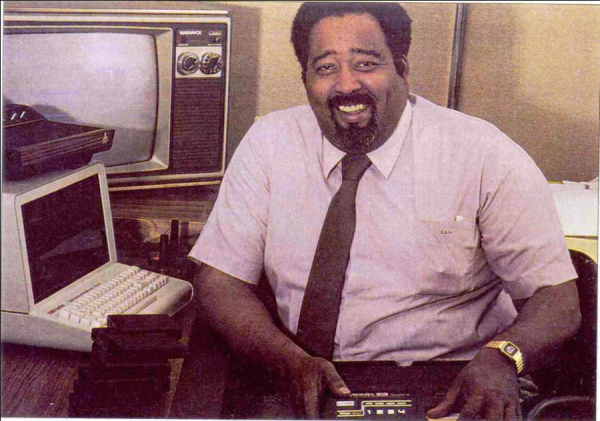
STEM-azing Facts About Jerry Lawson


Jerry Lawson and the gaming console that he invented. 


Gerald Anderson "Jerry"  Lawson (December 1, 1940 - April 9, 2011) was an African American electronic engineer known for his work in designing the Fairchild Channel F video game console.

The late Gerald Anderson was only one of two African Americans (the other being Ron Jones) to be a part of the exclusive Homebrew Computer Club in Silicon Valley. Other notables in the group were Steve Jobs and Steve Wozniak. The club began in 1975, when hobbyist, most with an electronic engineering or computer programming background, met to talk about the Altair 8800 and to exchange  schematics and programming tips.

Here are three facts about the Brooklyn born, self-taught electronic engineer that you might not know either:

1) Lawson was a self-taught engineer - While growing up in the projects of Queens in New 
    York City, Lawson got a start on his lifelong tinkering. His love for all things electronic and 
    gadget-y compelled him toward the engineer side of things. As a youth, he operated his own 
    ham radio and as a teenager he made money by repairing his neighbors' television sets.

2) Lawson founded and ran his own company - Videosoft, a video game development 
    company, was created by Lawson, who used it to produce cartridges for the Atari 2600. 
    When the 2600 came out, it effectively made the Channel F obsolete. Unfortunately, the 
    company only released one, which was a technician's tool called Color Bar Generator.

3) Lawson produced one of the industry's earliest arcade games - Debuting in a southern 
    California pizzeria only a few months after Allan Alcorn's Pong, Lawson's Demolition 
    Derby marked one of the earliest arcade games in the industry. Lawson would go on to 
    work with the Stanford University mentor program in an attempt to write a book on his 
    career.

For more facts on this great self-taught engineer please read Kevin L. Clark's Tech Times article on the life and times of Gerald Anderson "Jerry" Lawson. 

Now lets take a closer look at and see how the students in expanded learning program 
have been engaged in STEM activities during the month of January.


Name of Expanded Learning Program Provider: Target Excellence

Name of District(s): Elk Grove Unified School District and Sacramento City Unified  School District

Name of School Site: Roy Herburger Elementary (EGUSD), 
Sierra Enterprise Elementary (EGUSD), Ethel I. Baker (SCUSD)

Grade Level of Activity: 5th and 6th

Number of Students Who Took Part in The Activity: 20 per site

Type of Activities: Human Circuit - Conductors and Insulators, 

Catalytic Decomposition of Hydrogen Peroxide by Potassium Iodide,
Resonance: Tibetan Singing Bowls, Dancing Water, and Thunder Tubes,
Engineering Adventures

Learning Objectives of each Activity:

Human Circuit - Conductors and Insulators:

  • Understand that electricity is nothing more than free electrons moving from atom to atom through a material
  • Understand that the flow is called a current that goes in one direction at a time, and can be given a very strong charge or a very weak charge
  • Differentiate between conductors and insulators
  • Understand that transistors are electronic switches
Target Excellence learning about circuits while creating a human circuit.
Catalytic Decomposition of Hydrogen Peroxide by Potassium Iodide:
  • Understand the hazards and take the necessary precautions (e.g. wearing gloves and goggles)
  • Understand that the decomposition of hydrogen peroxide in the presence of iodide ion occurs in two steps: 1) H2O2 (aq) + I- (aq) = H2O (1) + OI- (aq) 2) H2O2 (aq) + OI- (aq) = H2O (1) + O2 (g) + I- (aq)
  • Differentiate between an exothermic and endothermic reaction
  • Understand that hydrogen peroxide molecules are very unstable and naturally decompose into water and oxygen gas
  • Understand that potassium iodide operated as a catalyst 
Target Excellence students learning about Catalytic Decomposition.

Resonance: Tibetan Singing Bowls, Dancing Water, and Thunder Tubes:
  • Understand that when an object vibrates at the natural frequency of another object resonance occurs
  • Identify Chladni (interference) patterns
  • Understand that every object has a natural frequency that vibrates when it is disturbed 
  • Understand that standing waves are produced by t he addition of two identical waves traveling simultaneously in opposite directions
  • Identify that hollow cavities are produced by the addition of two identical waves traveling simultaneously in opposite directions
  • Apply their knowledge to solve engineering problems relating to resonance
Engineering Adventures:
  • Learn that they can use the Engineering Design Process to solve problems
  • Learn that engineers design technologies that solve problems
  • Learn that they have talent and potential for designing and improving technologies
  • Be engaged in open ended challenges that are directly tied to NGSS standards
  • Learn to work in collaborative groups
Target Excellence students showing off their marshmallow tower.


A Target Excellence student writes in their Engineering Journal.

For more information on the above STEM activities please contact Jenna Boyd at jenna.boyd@targetexcellence.org


STEM / Expanded Learning and Other Pertinent Educational Articles: 

1) Save After School (Website on how individuals and organizations can work
    to sustain and increase the ASES program in California)

2) Why Talking about the Brain Can Empower Learners (KQED December 2014)

3) Promoting Literacy and Empathy in the Artroom 
    (Kimberly Campisano, January 26, 2016; KQED)

4) Stanford Study: "Culturally Relevant" Teaching Boosts GPA, Attendance for At-Risk Youth 
   (David Love, January 26, 2016; Atlanta Backstar)

5) What Core Skills Do Teachers Need to Be Effective? 
    (Emily Hanford, October 20, 2015; American Radioworks)

6) How a Lincoln High teacher gets all of his students to pass the AP Calculus exam
    (Steve Lopez, February 3, 2016; LA Times)

7) Know Thyself: Developing Your Inner Leader (National Afterschool Association)

8) SEL Skills and Employability (National Afterschool Association)

9) Finding the Math in Storybooks for Young Children 
    (Herbert P. Ginsburg, February 2, 2016, KQED)

10) Top 10 Time Tips for Trainers (Laura Stack, Training Magazine)

11) Major Push by White House to Increase Computer Science Skills 
      (Lauren Camera, January 30, 2016; US News)

12) California Case Studies Promote Summer Learning Over Summer School
      (Marva Hinton, February 8, 2016; Education Week) 

13) The Math Revolution (The Atlantic March 2016)

14) How to Get Your Kids Interested in STEM (Without Forcing It on Them)
      (Melanie Pinola, January 6, 2016; Lifehacker)

15) The Key to Boosting English Learners' Language Skills? Challenging Content
      (Katrina Schwartz, July 10, 2015; KQED) 

16) What Kids Need From Grown-Ups (But Aren't Getting)
       (Corey Turner, February 9, 2016; NPR) 


STEM (and other interdisciplinary core content) Activities / Videos / Websites:

1) USGS Science Resources for Primary Grades (K-6)

2) Teacher Uses Legos To Explain Math To School Children
    (Architecture and Design, December 2015)

3) 5 of our favorite Ted-Ed Lessons written by #WomenInSTEM
    (Laura McClure, February 11, 2016; Ted-Ed Blog)

4) Lesson Plan: Teaching With Protest Music
    ( Michael Gonchar and Katherine Schulten, February 4, 2016; NY Times Blog)

5) Flocabulary - Educational Hip Hop (A Few Free Resources)

6) A Big Ideas video series on Growth Mindset (ClassDojo: 5 free videos for kids)

7) How Limited Internet Access Can Subtract From Kids' Education
    ( Alina Selyukh February 8, 2016, NPR Podcast)

8) Open Ed NGSS Resources (Open Ed)

9) The Science of Getting Kids Organized
    (Karen Brown, February 2, 2016; NPR Podcast)

10) Youcubed (Stanford University Math Website with Resources for 
      Students and Parents)

11) New Resources on Social and Emotional Learning (AIR)

12) Stretchy Universe Slime (NASA Activity)

13) Sun Paper (NASA Activity)

14) Comet on a Stick (NASA Activity)

15) Make a stained glass Earth (NASA Activity)


STEM / Educational Grants:

1) National Council of Teachers of Mathematics (NCTM): Enhancing Student 
    Mathematics Learning Through the Use of Tools and Technology  
    ($3,000 grants are available)
    (Deadline: May 6, 2016)

2) Math Moves U: Math Hero Award (Math hero receives a $2,500 grant and school 
    receives a matching award) (Deadline: Applications open Spring of 2016)

3) Youth Service America (Grant Database) (Currently no grants available at 
    this time, but a great site to add to your "History" bar. )

4) Best Satellite Providers: Technology Grants for Educators 
    17 Resources for Future Proof Kids
    (Deadline: Varies by Grant Opportunity)


    (This webpage has been updated since January and offers new grants)


STEM / Misc. Professional Development / Contest / Events:


1) Enter the Cypher: Hip Hop Education Series - A three session workshop
    series focused around the best practices to empower Expanded Learning 
    Practitioners to use Hip Hop as an engaging and exciting tool within their 
    program. Presented by the Low End Theory Collaborative
    (Dates: February 17, March 15, and April 12) 
    (Fee: $22.00 per session)


    (Free) (February 24, 2016)

    (Free) (March 23, 2016)

    ($150 per participant) (April 22, 2016)

Thanks again for all that you do in the field. Please keep us posted about STEM events/activities in your area. Please feel free to contact us at any time.

Monica Gonzalez-Williams (SCOE: Region 3: After School Regional Lead):
mgonzalez@scoe.net

Phil Romig (SCOE: Science Curriculum Specialist): promig@scoe.net

Mark Drewes (SCOE: Project Specialist II: After School) mdrewes@scoe.net